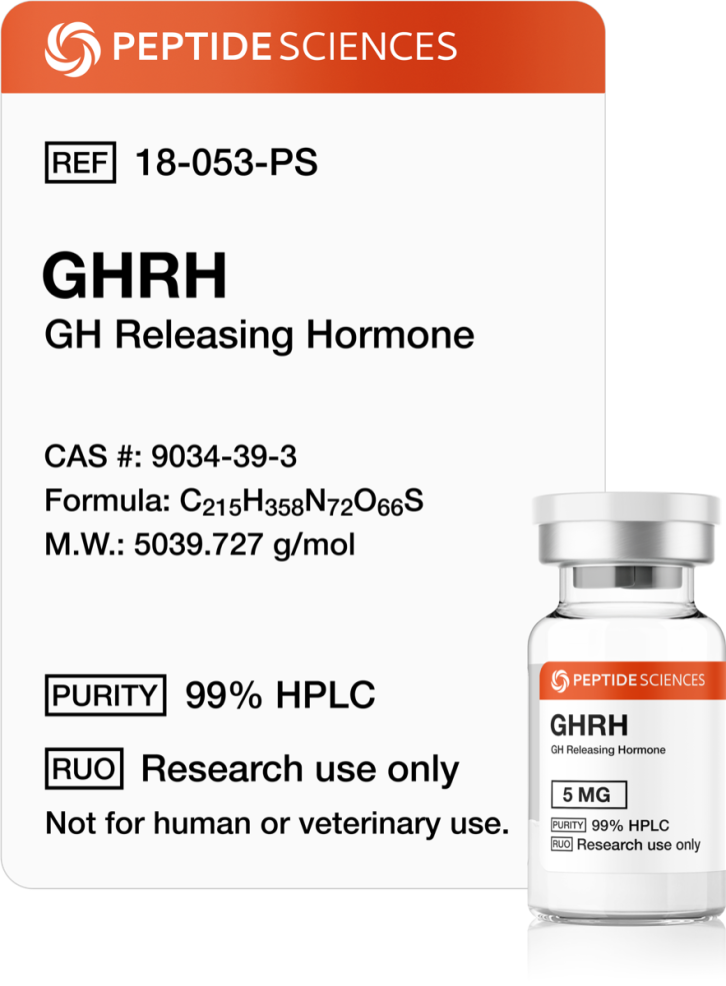
GHRH 5mg

$95.00
GHRH (Growth Hormone–Releasing Hormone) is a 44–amino acid hypothalamic research peptide that stimulates growth hormone release via activation of the GHRH receptor. It triggers adenylate cyclase and cAMP signaling pathways, resulting in GH synthesis and secretion in experimental models. GHRH is utilized in neuroendocrine and receptor biology research to explore hypothalamic–pituitary regulation and peptide hormone receptor dynamics.
For research use only. Not for human consumption.
References:
Ling N et al., Proc Natl Acad Sci USA, 1984 81(13):4302–4306
Thorner MO et al., J Clin Endocrinol Metab, 1986 63(3):638–643
Frohman LA et al., Endocr Rev, 2001 22(6):606–648
GHRH 5mg – Buy High-Quality GHRH 5mg Online
Looking to buy GHRH 5mg for your research laboratory? You have come to the right place. We currently have GHRH 5mg for sale and it is in stock and ready for immediate shipping. Our GHRH 5mg is of the highest purity, making it the best GHRH 5mg online for scientific studies.
Product Overview
GHRH 5mg is a premium research compound widely utilized in various scientific studies. Researchers seeking to buy GHRH 5mg online often prioritize purity and consistency. This compound has been studied extensively for its unique biochemical properties and its role in cellular pathways.
| Properties | |
|---|---|
| Molecular Formula | C215H358N72O66S |
| Molecular Weight | 5040 |
| Monoisotopic Mass | 5036.6591258 |
| Polar Area | 2360 |
| Complexity | 12500 |
| XLogP | -27.2 |
| Heavy Atom Count | 354 |
| Hydrogen Bond Donor Count | 83 |
| Hydrogen Bond Acceptor Count | 76 |
| Rotatable Bond Count | 183 |
| PubChem LCSS | Somatoliberin (human pancreatic islet) Laboratory Chemical Safety Summary |
| Identifiers | |
|---|---|
| CID | 44134750 |
| InChI | InChI=1S/C215H358N72O66S/c1-24-106(15)166(285-174(318)112(21)251-193(337)145(91-163(309)310)270-173(317)109(18)249-175(319)119(218)86-115-49-53-117(293)54-50-115)208(352)278-142(87-114-39-27-26-28-40-114)200(344)287-168(113(22)292)209(353)279-144(90-157(225)301)199(343)283-150(99-291)204(348)274-141(88-116-51-55-118(294)56-52-116)197(341)261-126(47-37-78-243-214(235)236)181(325)260-122(42-30-32-73-217)192(336)284-165(105(13)14)206(350)277-137(82-101(5)6)178(322)247-95-160(304)253-129(58-65-152(220)296)185(329)272-140(85-104(11)12)196(340)282-147(96-288)202(346)252-111(20)172(316)256-124(45-35-76-241-212(231)232)180(324)259-121(41-29-31-72-216)184(328)271-139(84-103(9)10)195(339)273-138(83-102(7)8)194(338)266-133(61-68-155(223)299)190(334)276-146(92-164(311)312)201(345)286-167(107(16)25-2)207(351)268-135(71-80-354-23)191(335)281-148(97-289)203(347)262-127(48-38-79-244-215(237)238)182(326)264-131(59-66-153(221)297)187(331)263-128(57-64-151(219)295)177(321)246-94-159(303)254-130(62-69-161(305)306)186(330)280-149(98-290)205(349)275-143(89-156(224)300)198(342)267-132(60-67-154(222)298)188(332)265-134(63-70-162(307)308)189(333)258-120(43-33-74-239-210(227)228)176(320)245-93-158(302)248-108(17)170(314)255-123(44-34-75-240-211(229)230)179(323)250-110(19)171(315)257-125(46-36-77-242-213(233)234)183(327)269-136(169(226)313)81-100(3)4/h26-28,39-40,49-56,100-113,119-150,165-168,288-294H,24-25,29-38,41-48,57-99,216-218H2,1-23H3,(H2,219,295)(H2,220,296)(H2,221,297)(H2,222,298)(H2,223,299)(H2,224,300)(H2,225,301)(H2,226,313)(H,245,320)(H,246,321)(H,247,322)(H,248,302)(H,249,319)(H,250,323)(H,251,337)(H,252,346)(H,253,304)(H,254,303)(H,255,314)(H,256,316)(H,257,315)(H,258,333)(H,259,324)(H,260,325)(H,261,341)(H,262,347)(H,263,331)(H,264,326)(H,265,332)(H,266,338)(H,267,342)(H,268,351)(H,269,327)(H,270,317)(H,271,328)(H,272,329)(H,273,339)(H,274,348)(H,275,349)(H,276,334)(H,277,350)(H,278,352)(H,279,353)(H,280,330)(H,281,335)(H,282,340)(H,283,343)(H,284,336)(H,285,318)(H,286,345)(H,287,344)(H,305,306)(H,307,308)(H,309,310)(H,311,312)(H4,227,228,239)(H4,229,230,240)(H4,231,232,241)(H4,233,234,242)(H4,235,236,243)(H4,237,238,244) |
| InChIKey | JAHCMOSSKRAPEL-UHFFFAOYSA-N |
| Isometric SMILES | CCC(C)C(C(=O)NC(CC1=CC=CC=C1)C(=O)NC(C(C)O)C(=O)NC(CC(=O)N)C(=O)NC(CO)C(=O)NC(CC2=CC=C(C=C2)O)C(=O)NC(CCCNC(=N)N)C(=O)NC(CCCCN)C(=O)NC(C(C)C)C(=O)NC(CC(C)C)C(=O)NCC(=O)NC(CCC(=O)N)C(=O)NC(CC(C)C)C(=O)NC(CO)C(=O)NC(C)C(=O)NC(CCCNC(=N)N)C(=O)NC(CCCCN)C(=O)NC(CC(C)C)C(=O)NC(CC(C)C)C(=O)NC(CCC(=O)N)C(=O)NC(CC(=O)O)C(=O)NC(C(C)CC)C(=O)NC(CCSC)C(=O)NC(CO)C(=O)NC(CCCNC(=N)N)C(=O)NC(CCC(=O)N)C(=O)NC(CCC(=O)N)C(=O)NCC(=O)NC(CCC(=O)O)C(=O)NC(CO)C(=O)NC(CC(=O)N)C(=O)NC(CCC(=O)N)C(=O)NC(CCC(=O)O)C(=O)NC(CCCNC(=N)N)C(=O)NCC(=O)NC(C)C(=O)NC(CCCNC(=N)N)C(=O)NC(C)C(=O)NC(CCCNC(=N)N)C(=O)NC(CC(C)C)C(=O)N)NC(=O)C(C)NC(=O)C(CC(=O)O)NC(=O)C(C)NC(=O)C(CC3=CC=C(C=C3)O)N |
| Canonical SMILES | CCC(C)C(C(=O)NC(CC1=CC=CC=C1)C(=O)NC(C(C)O)C(=O)NC(CC(=O)N)C(=O)NC(CO)C(=O)NC(CC2=CC=C(C=C2)O)C(=O)NC(CCCNC(=N)N)C(=O)NC(CCCCN)C(=O)NC(C(C)C)C(=O)NC(CC(C)C)C(=O)NCC(=O)NC(CCC(=O)N)C(=O)NC(CC(C)C)C(=O)NC(CO)C(=O)NC(C)C(=O)NC(CCCNC(=N)N)C(=O)NC(CCCCN)C(=O)NC(CC(C)C)C(=O)NC(CC(C)C)C(=O)NC(CCC(=O)N)C(=O)NC(CC(=O)O)C(=O)NC(C(C)CC)C(=O)NC(CCSC)C(=O)NC(CO)C(=O)NC(CCCNC(=N)N)C(=O)NC(CCC(=O)N)C(=O)NC(CCC(=O)N)C(=O)NCC(=O)NC(CCC(=O)O)C(=O)NC(CO)C(=O)NC(CC(=O)N)C(=O)NC(CCC(=O)N)C(=O)NC(CCC(=O)O)C(=O)NC(CCCNC(=N)N)C(=O)NCC(=O)NC(C)C(=O)NC(CCCNC(=N)N)C(=O)NC(C)C(=O)NC(CCCNC(=N)N)C(=O)NC(CC(C)C)C(=O)N)NC(=O)C(C)NC(=O)C(CC(=O)O)NC(=O)C(C)NC(=O)C(CC3=CC=C(C=C3)O)N |
| IUPAC Name | 4-[[2-[[5-amino-2-[[5-amino-2-[[2-[[2-[[2-[[2-[[2-[[5-amino-2-[[2-[[2-[[6-amino-2-[[2-[2-[[2-[[2-[[5-amino-2-[[2-[[2-[[2-[[6-amino-2-[[2-[[2-[[2-[[4-amino-2-[[2-[[2-[[2-[2-[[2-[2-[[2-amino-3-(4-hydroxyphenyl)propanoyl]amino]propanoylamino]-3-carboxypropanoyl]amino]propanoylamino]-3-methylpentanoyl]amino]-3-phenylpropanoyl]amino]-3-hydroxybutanoyl]amino]-4-oxobutanoyl]amino]-3-hydroxypropanoyl]amino]-3-(4-hydroxyphenyl)propanoyl]amino]-5-carbamimidamidopentanoyl]amino]hexanoyl]amino]-3-methylbutanoyl]amino]-4-methylpentanoyl]amino]acetyl]amino]-5-oxopentanoyl]amino]-4-methylpentanoyl]amino]-3-hydroxypropanoyl]amino]propanoylamino]-5-carbamimidamidopentanoyl]amino]hexanoyl]amino]-4-methylpentanoyl]amino]-4-methylpentanoyl]amino]-5-oxopentanoyl]amino]-3-carboxypropanoyl]amino]-3-methylpentanoyl]amino]-4-methylsulfanylbutanoyl]amino]-3-hydroxypropanoyl]amino]-5-carbamimidamidopentanoyl]amino]-5-oxopentanoyl]amino]-5-oxopentanoyl]amino]acetyl]amino]-5-[[1-[[4-amino-1-[[5-amino-1-[[1-[[1-[[2-[[1-[[1-[[1-[[1-[(1-amino-4-methyl-1-oxopentan-2-yl)amino]-5-carbamimidamido-1-oxopentan-2-yl]amino]-1-oxopropan-2-yl]amino]-5-carbamimidamido-1-oxopentan-2-yl]amino]-1-oxopropan-2-yl]amino]-2-oxoethyl]amino]-5-carbamimidamido-1-oxopentan-2-yl]amino]-4-carboxy-1-oxobutan-2-yl]amino]-1,5-dioxopentan-2-yl]amino]-1,4-dioxobutan-2-yl]amino]-3-hydroxy-1-oxopropan-2-yl]amino]-5-oxopentanoic acid |
Overview
Growth hormone releasing hormone (GHRH), also referenced as growth hormone releasing factor (GHRF), somatocrinin, or somatoliberin, is an endogenous hypothalamic peptide widely used in laboratory research as a reference ligand for interrogating growth hormone releasing hormone receptor (GHRHR) signaling. In controlled experimental systems, GHRH supports mechanistic studies of receptor activation, second-messenger coupling, and downstream transcriptional responses in pituitary-derived cellular models and in-vivo animal frameworks. Because GHRH signaling is frequently modeled as a temporally patterned neuroendocrine input, research designs often focus on stimulus timing, receptor responsiveness, and pathway readouts under defined exposure conditions. These investigations emphasize receptor pharmacology and signaling kinetics rather than any applied or outcome-based interpretation.
Biochemical Characteristics
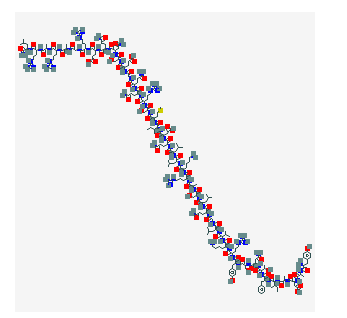
Source: PubChem
Sequence: DL-Tyr-DL-Ala-DL-Asp-DL-Ala-DL-xiIle-DL-Phe-DL-xiThr-DL-Asn-DL-Ser-DL-Tyr-DL-Arg-DL-Lys-DL-Val-DL-Leu-Gly-DL-Gln-DL-Leu-DL-Ser-DL-Ala-DL-Arg-DL-Lys-DL-Leu-DL-Leu-DL-Gln-DL-Asp-DL-xiIle-DL-Met-DL-Ser-DL-Arg-DL-Gln-DL-Gln-Gly-DL-Glu-DL-Ser-DL-Asn-DL-Gln-DL-Glu-DL-Arg-Gly-DL-Ala-DL-Arg-DL-Ala-DL-Arg-DL-Leu
Molecular Formula: C215H358N72O66S
Molecular Weight: 5039.727 g/mol
PubChem CID: 44134750
CAS Number: 9034-39-3
Synonyms: Growth Hormone Releasing Factor, Somatocrinin, Somatoliberin
GHRH peptide variants have been reported across a range of sequence lengths in the literature (commonly described in the ~37–44 amino acid range). In preclinical workflows, variant length can be evaluated for receptor engagement behavior, potency relationships in cell-based assays, and stability in assay matrices, supporting sequence–activity mapping at GHRHR.
Research Applications
1. Receptor Pharmacology & Ligand Benchmarking
GHRH is used as a reference ligand in GHRHR activation assays to benchmark receptor responsiveness, concentration–response behavior, and signaling bias across second-messenger and phosphorylation readouts. These assays are commonly conducted in pituitary-derived cell models or engineered receptor-expression systems using cAMP-linked and downstream pathway endpoints.
2. Temporal Signaling & Desensitization Modeling
In systems biology and endocrine-axis modeling workflows, GHRH can be applied to probe how stimulus timing influences receptor resensitization, internalization kinetics, and downstream transcriptional programs. These designs evaluate mechanistic features of patterned signaling rather than any outcome-based interpretation.
3. Tissue Expression Datasets & Peripheral Signaling Hypotheses
Expression atlases and research datasets have reported GHRH transcripts across tissue contexts, motivating experimental designs that examine local GHRH/GHRHR signaling in controlled cellular systems and ectopic-expression models used in experimental biology.[1]
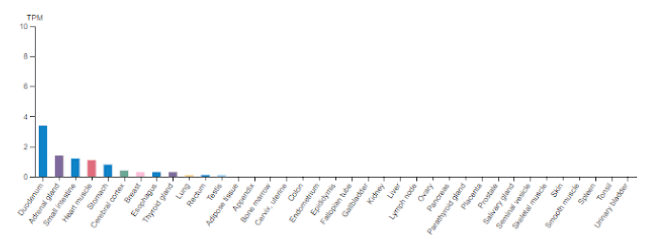
Source: The Human Protein Atlas
4. Neuroendocrine Circuitry in Animal Models
Rodent studies have evaluated mechanistic relationships between GHRH signaling and sleep-state regulation, using genetic and pharmacologic perturbations to interrogate hypothalamic circuitry and receptor-linked phenotypes in vivo.[2], [3]
Pathway / Mechanistic Context
GHRH engages GHRHR, a receptor class commonly investigated for G protein–coupled signaling that is frequently mapped to cAMP/PKA-associated second-messenger pathways in pituitary-relevant experimental systems. Downstream mechanistic readouts in cellular assays may include cAMP accumulation, kinase activation states, transcription factor modulation, and transcriptomic shifts in hormone-axis gene panels under controlled conditions.
In vivo, mechanistic studies often evaluate how hypothalamic peptide signaling interfaces with stress-related inputs and metabolic state, including models where upstream neuropeptide expression and pituitary responsiveness are perturbed. For example, obesity-associated changes in hypothalamic GHRH gene expression have been evaluated in genetically obese rodent models as a mechanistic framework for altered somatotropic signaling.[4]
Preclinical Research Summary
Preclinical investigations of GHRH include receptor-function studies in pituitary-derived and engineered cellular models, as well as in-vivo rodent studies probing neuroendocrine signaling interfaces. Published animal work has evaluated sleep-state regulation in mice with altered GHRH receptor function and has explored inflammatory pain signaling interfaces in rodent models of localized inflammatory hyperalgesia.[3], [5]
Additional preclinical literature has examined pharmacologic antagonism of growth hormone–releasing hormone pathways in controlled cellular systems, including inflammation-linked proliferation readouts in epithelial model contexts.[6]
Form & Analytical Testing
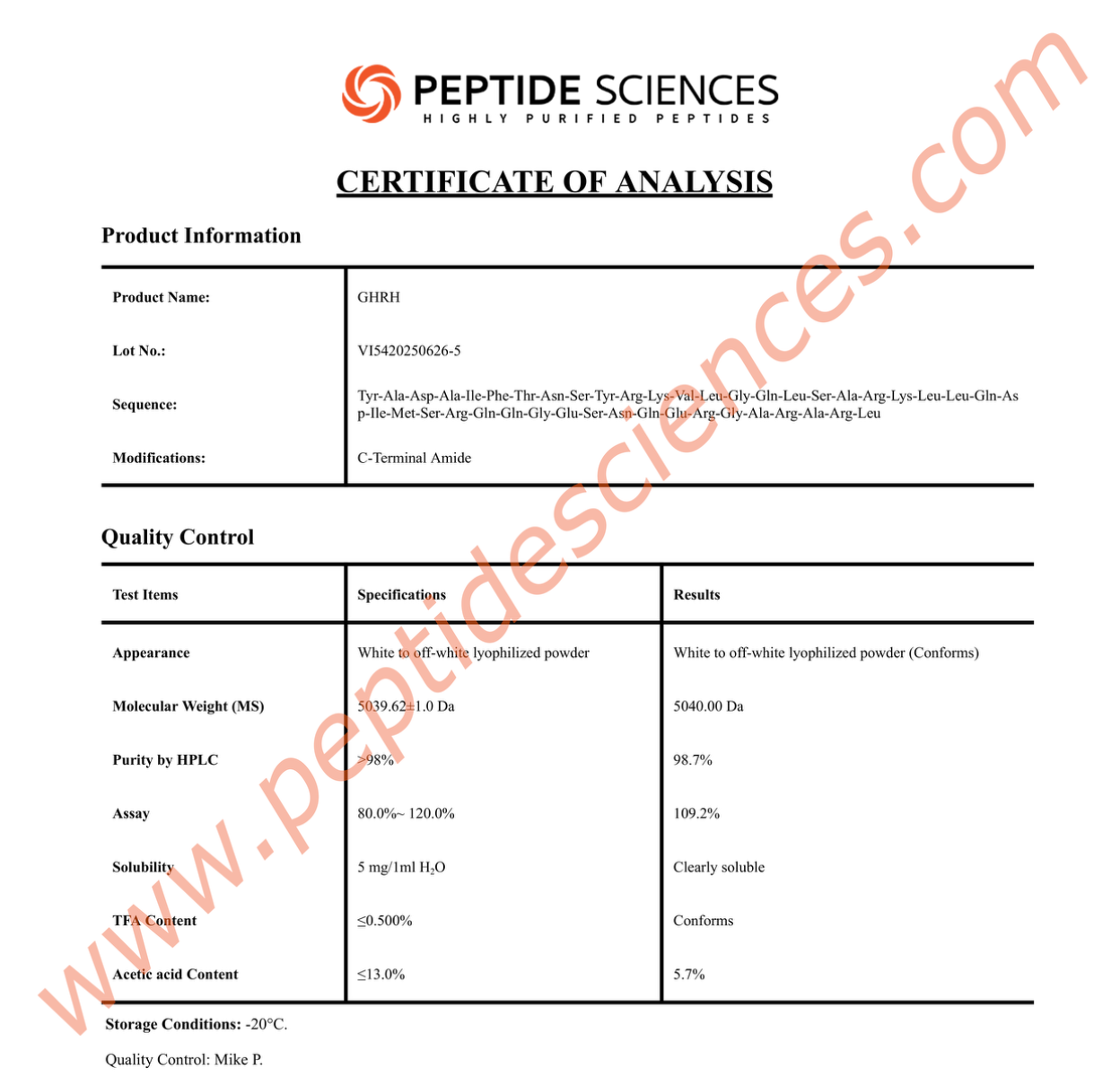
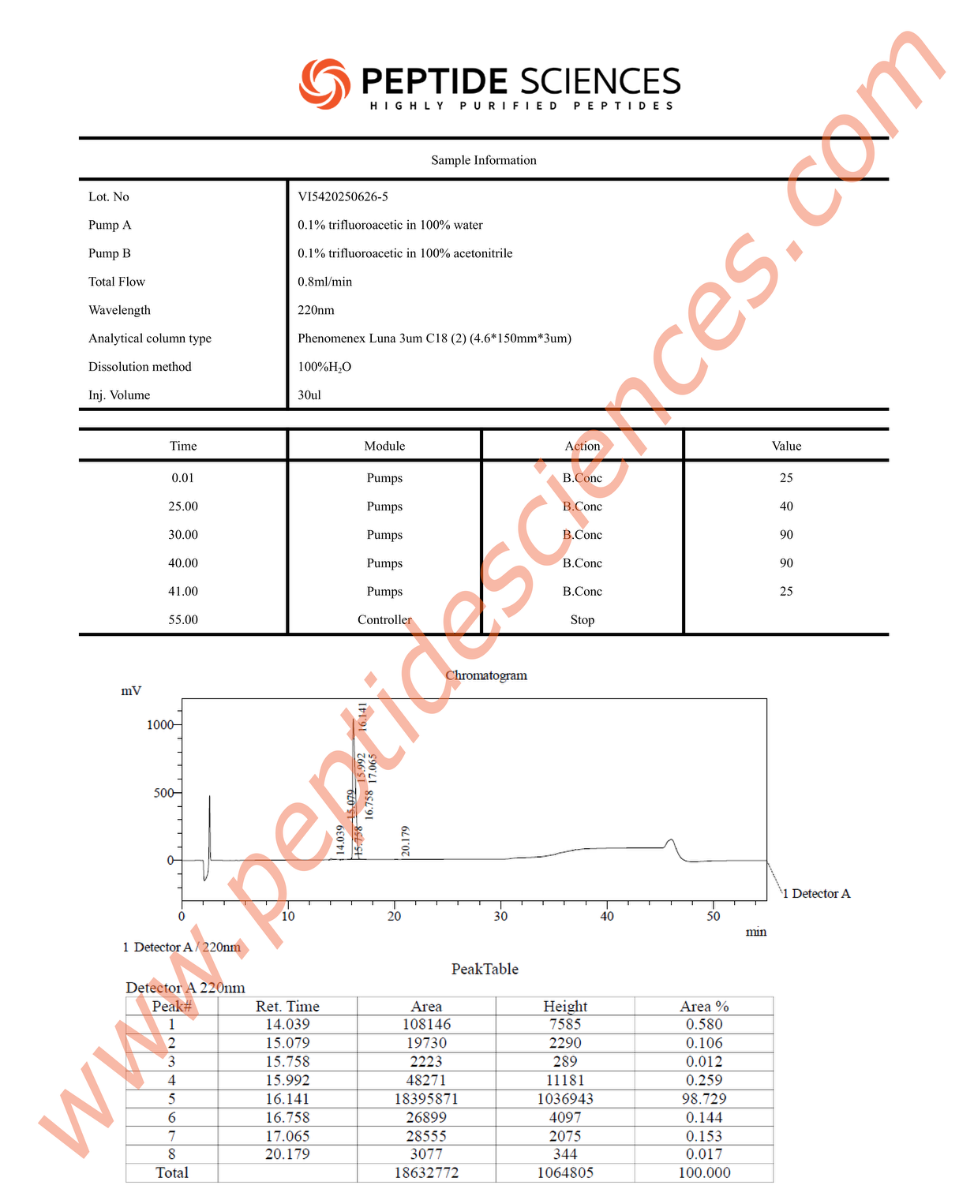
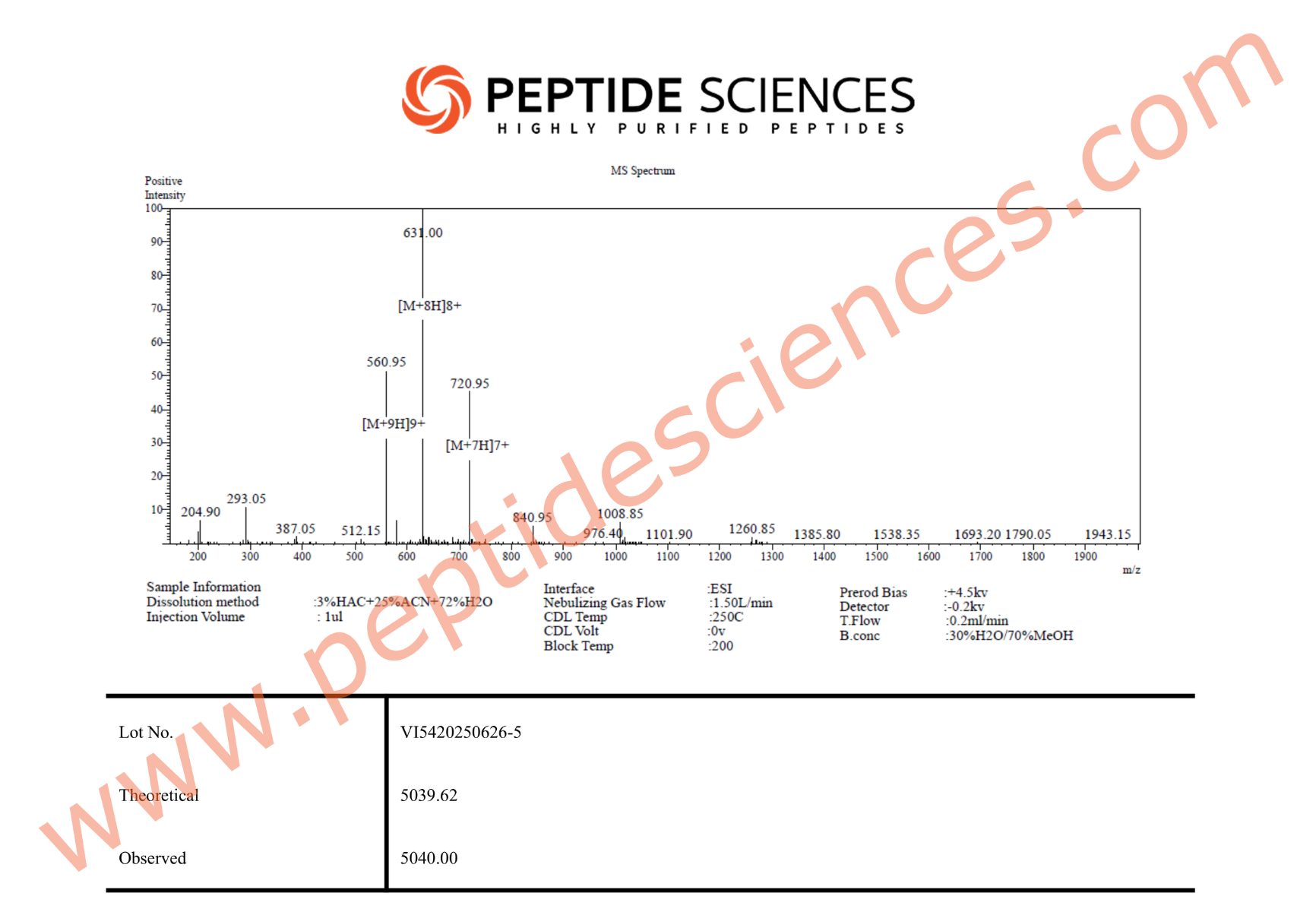
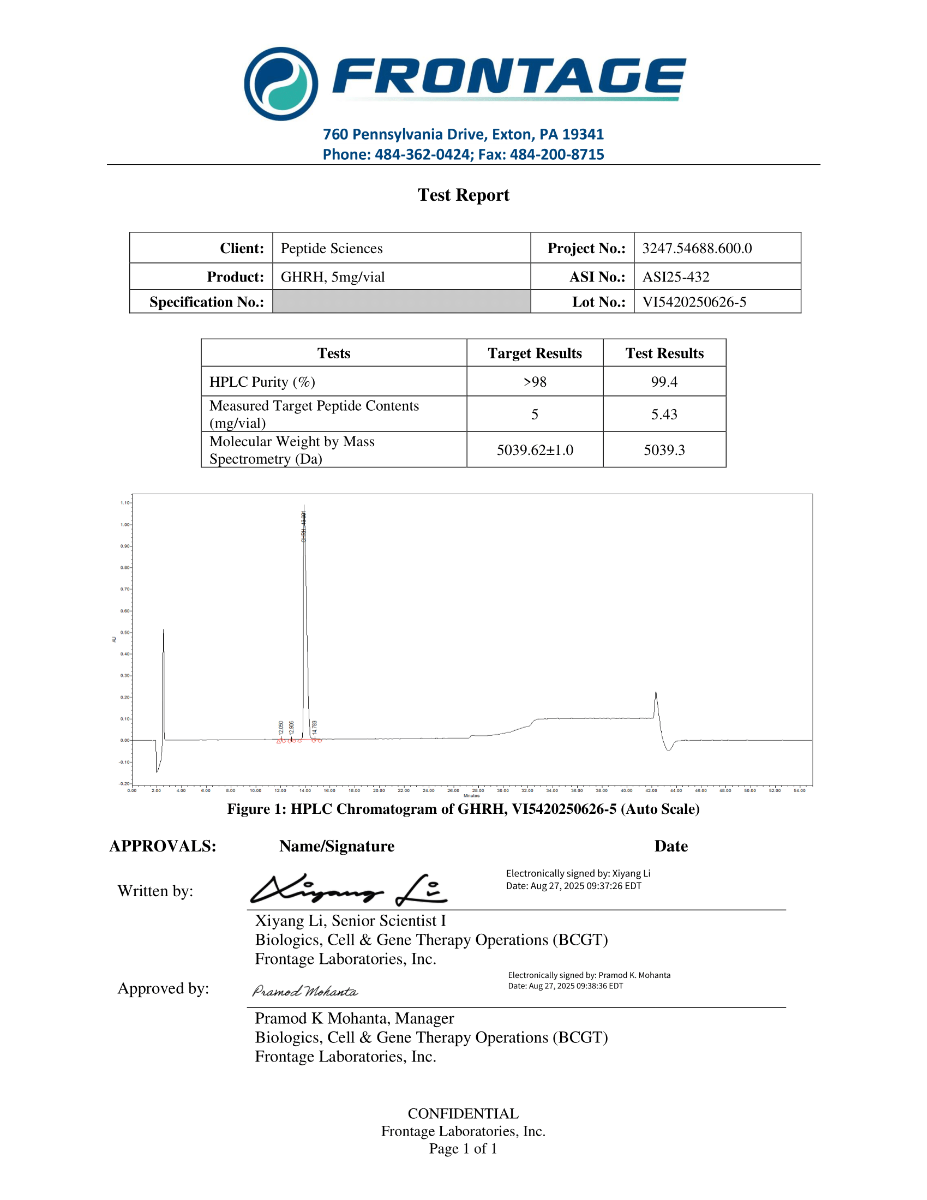
Product characterization in RUO workflows commonly includes identity confirmation and purity profiling using analytical techniques such as HPLC and mass spectrometry. When documentation is provided for a specific lot, it is used for laboratory quality review (e.g., identity, purity, and consistency) within the experimental context.
Referenced Citations
- “Tissue expression of GHRH – Summary – The Human Protein Atlas.”
- F. Obal and J. M. Krueger, “GHRH and sleep,” Sleep Med. Rev., vol. 8, no. 5, pp. 367–377, Oct. 2004.
- F. Obal, J. Alt, P. Taishi, J. Gardi, and J. M. Krueger, “Sleep in mice with nonfunctional growth hormone-releasing hormone receptors,” Am. J. Physiol. Regul. Integr. Comp. Physiol., vol. 284, no. 1, pp. R131-139, Jan. 2003.
- I. Ahmad, J. A. Finkelstein, T. R. Downs, and L. A. Frohman, “Obesity-associated decrease in growth hormone-releasing hormone gene expression: a mechanism for reduced growth hormone mRNA levels in genetically obese Zucker rats,” Neuroendocrinology, vol. 58, no. 3, pp. 332–337, Sep. 1993.
- R. S. Talhouk, N. E. Saadé, G. Mouneimne, C. A. Masaad, and B. Safieh-Garabedian, “Growth hormone releasing hormone reverses endotoxin-induced localized inflammatory hyperalgesia without reducing the upregulated cytokines, nerve growth factor and gelatinase activity,” Prog. Neuropsychopharmacol. Biol. Psychiatry, vol. 28, no. 4, pp. 625–631, Jul. 2004.
- P. Popovics, A. V. Schally, L. Salgueiro, K. Kovacs, and F. G. Rick, “Antagonists of growth hormone-releasing hormone inhibit proliferation induced by inflammation in prostatic epithelial cells,” Proc. Natl. Acad. Sci., vol. 114, no. 6, pp. 1359–1364, Feb. 2017.
ALL ARTICLES AND PRODUCT INFORMATION PROVIDED ON THIS WEBSITE ARE FOR INFORMATONAL AND EDUCATIONAL PURPOSES ONLY.
RUO Disclaimer
The products offered on this website are furnished for in-vitro studies only. In-vitro studies (Latin: in glass) are performed outside of the body. These products are not medicines or drugs and have not been approved by the FDA to prevent, treat or cure any medical condition, ailment or disease. Bodily introduction of any kind into humans or animals is strictly forbidden by law.
For Laboratory Research Only. Not for human use, medical use, diagnostic use, or veterinary use.
Storage Instructions:
All of our products are manufactured using the Lyophilization (Freeze Drying) process, which ensures that our products remain 100% stable for shipping for up to 3-4 months.
Once the peptides are reconstituted (mixed with bacteriostatic water), they must be stored in the fridge to maintain stability. After reconstitution, the peptides will remain stable for up to 30 days.
Lyophilization is a unique dehydration process, also known as cryodesiccation, where the peptides are frozen and then subjected to low pressure. This causes the water in the peptide vial to sublimate directly from solid to gas, leaving behind a stable, crystalline white structure known as lyophilized peptide. The puffy white powder can be stored at room temperature until you’re ready to reconstitute it with bacteriostatic water.
Once peptides have been received, it is imperative that they are kept cold and away from light. If the peptides will be used immediately, or in the next several days, weeks or months, short-term refrigeration under 4C (39F) is generally acceptable. Lyophilized peptides are usually stable at room temperatures for several weeks or more, so if they will be utilized within weeks or months such storage is typically adequate.
However, for longer term storage (several months to years) it is more preferable to store peptides in a freezer at -80C (-112F). When storing peptides for months or even years, freezing is optimal in order to preserve the peptide’s stability.
Why Choose Our GHRH 5mg?
When you are looking for GHRH 5mg for sale, quality is paramount. Our products undergo rigorous testing to ensure they meet the strict requirements of laboratory environments. By choosing to buy GHRH 5mg from our store, you are guaranteed a product that is:
- High Purity (Tested for 99% )
- Fast Shipping – Always in stock
- Secure Packaging for Research Integrity
- Competitive Pricing for Bulk Orders
Specifications & Technical Data
| Feature | Specification |
|---|---|
| Product Name | GHRH 5mg |
| SKU | 49 |
| Purity | >99% |
| Form | Research Grade Compound |
| Availability | In Stock / For Sale |
Scientific Research & Clinical Applications
The research surrounding GHRH 5mg is vast. Scientists explore its potential in various metabolic and physiological models. For more detailed scientific data, you can visit PubMed to review the latest peer-reviewed literature regarding this compound.
Frequently Asked Questions
Where can I buy GHRH 5mg?
You can buy GHRH 5mg directly from our website. We provide a secure checkout and fast shipping to ensure your research stays on track.
Is GHRH 5mg in stock?
Yes, we currently have GHRH 5mg in stock. Orders are typically processed within 24 hours to ensure rapid delivery to your laboratory.
Related Research Products
If you are interested in GHRH 5mg, you may also want to explore these related products currently in stock:
Disclaimer: All products listed are for research purposes only. Not for human consumption.
Related products