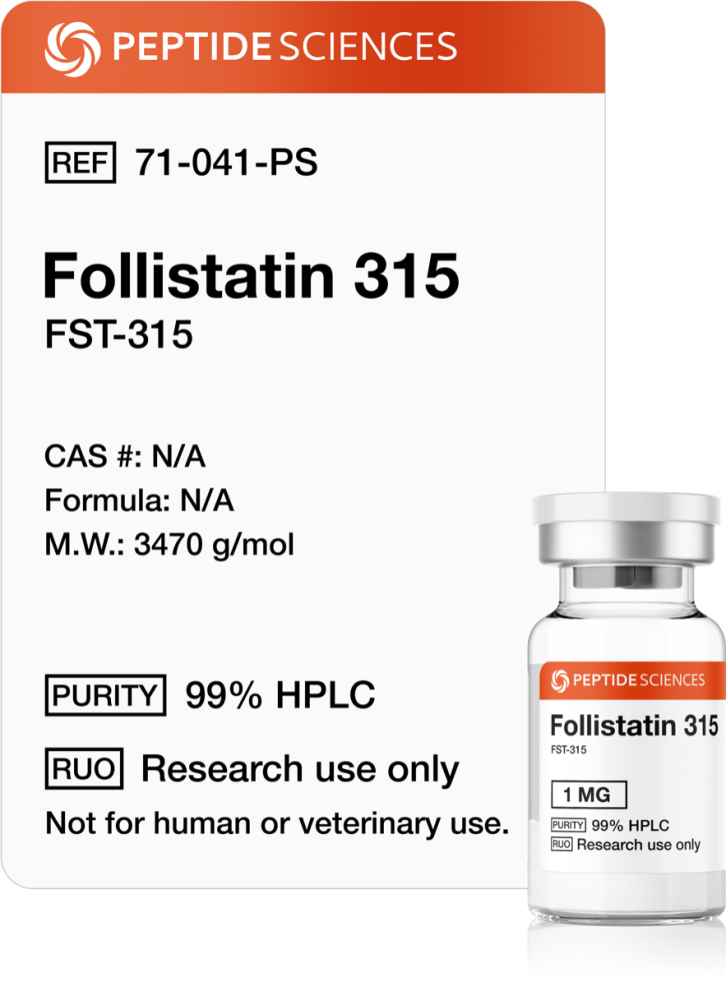
Follistatin 315 1mg
$155.00
Follistatin 315 is a research peptide isoform of the follistatin protein composed of 315 amino acids that binds and neutralizes activins and myostatin in experimental models. It modulates TGF-β family signaling and promotes muscle cell differentiation through Smad-dependent inhibition. Follistatin 315 is used in molecular and cellular research examining peptide–growth factor interactions.
For research use only. Not for human consumption.
References:
Sidis Y et al., Endocr Rev, 2001 22(5):726–729
Lee SJ et al., Proc Natl Acad Sci USA, 2001 98(16):9306–9311
Cash JN et al., J Biol Chem, 2009 284(13):9011–9020
Follistatin 315 1mg – Buy High-Quality Follistatin 315 1mg Online
Looking to buy Follistatin 315 1mg for your research laboratory? You have come to the right place. We currently have Follistatin 315 1mg for sale and it is in stock and ready for immediate shipping. Our Follistatin 315 1mg is of the highest purity, making it the best Follistatin 315 1mg online for scientific studies.
Product Overview
Follistatin 315 1mg is a premium research compound widely utilized in various scientific studies. Researchers seeking to buy Follistatin 315 1mg online often prioritize purity and consistency. This compound has been studied extensively for its unique biochemical properties and its role in cellular pathways.
Overview
Follistatin 315 is a naturally occurring isoform of the follistatin protein family, characterized by its capacity to bind and neutralize select members of the transforming growth factor-β (TGF-β) superfamily, including activins. This protein is utilized in laboratory research to investigate regulatory mechanisms governing growth factor sequestration, signaling modulation, and extracellular ligand availability.
Within experimental systems, follistatin 315 serves as a molecular tool for probing activin-dependent signaling dynamics across diverse biological models, including developmental, inflammatory, and tissue remodeling contexts.
Biochemical Characteristics
Structure of the unedited follistatin protein
Source: UniProt
Sequence: GNCWLRQAKNGRCQVLYKTELSKEECCSTGRLSTSWTEEDVNDNTLFKWMIFNGGAPNCIPCKETCENVDCGPGKKCRMNKKNKPRCVCAPDCSNITWKGPVCGLDGKTYRNECALLKARCKEQPELEVQYQGRCKKTCRDVFCPGSSTCVVDQTNNAYCVTCNRICPEPASSEQYLCGNDGVTYSSACHLRKATCLLGRSIGLAYEGKCIKAKSCEDIQCTGGKKCLWDFKVGRGRCSLCDELCPDSKSDEPVCASDNATYASECAMKEAACSSGVLLEVKHSGSCNSISEDTEEEEEDEDQDYSFPISSILEW
Molecular Weight: 34.7 kDa
PubChem CID: 178101631
Synonyms: Activin-Binding Protein, FST, FST-315
Research Applications
- Investigation of activin sequestration and ligand–receptor availability
- Modulation studies within TGF-β superfamily signaling networks
- Exploration of extracellular matrix and tissue remodeling pathways
- Evaluation of signaling feedback loops in inflammatory and developmental models
- Use as a comparative reagent in isoform-specific follistatin research
Pathway / Mechanistic Context
Follistatin 315 functions primarily through high-affinity binding of activins, thereby preventing interaction with activin receptors and downstream SMAD-mediated signaling. This neutralization alters transcriptional responses regulated by TGF-β family pathways, offering a mechanistic framework for studying growth factor bioavailability and signal attenuation.
Additional mechanistic investigations have examined interactions between follistatin and myostatin within controlled experimental systems, contributing to broader understanding of ligand competition and pathway crosstalk.
Preclinical Research Summary
Preclinical studies utilizing cellular and animal models have explored follistatin-associated modulation of developmental signaling, inflammatory regulation, vascular biology, and fibrotic processes. Genetic disruption and recombinant protein studies have provided insights into isoform-specific functions and tissue-dependent signaling outcomes.
These investigations contribute to foundational knowledge of activin-follistatin regulatory systems without implying translational or clinical application.
Form & Analytical Testing
- Supplied as a research-grade reagent
- Identity confirmed via analytical characterization
- Intended for controlled laboratory environments only
- Not formulated for diagnostic, therapeutic, or clinical use
Referenced Citations
- “‘Mighty mice’ made mightier,” EurekAlert! [Online]. Available: http://www.eurekalert.org/pub_releases/2007-08/jhmi-mm082407.php. [Accessed: 27-Jun-2019].
- “Quadrupling Muscle Mass in Mice by Targeting TGF-ß Signaling Pathways.” [Online]. Available: https://journals.plos.org/plosone/article?id=10.1371/journal.pone.0000789. [Accessed: 27-Jun-2019].
- F. F. Rose, V. B. Mattis, H. Rindt, and C. L. Lorson, “Delivery of recombinant follistatin lessens disease severity in a mouse model of spinal muscular atrophy,” Hum. Mol. Genet., vol. 18, no. 6, pp. 997–1005, Mar. 2009. [PubMed]
- “Success Boosting Monkey Muscle Could Help Humans,” NPR.org. [Online]. Available: https://www.npr.org/templates/story/story.php?storyId=120316010. [Accessed: 27-Jun-2019].
- M. Diller et al., “The activin-follistatin anti-inflammatory cycle is deregulated in synovial fibroblasts,” Arthritis Res. Ther., vol. 21, no. 1, p. 144, Jun. 2019. [BMC]
- A. Papaporfyriou et al., “Activin A and follistatin in patients with asthma. Does severity make the difference?,” Respirol. Carlton Vic, vol. 22, no. 3, pp. 473–479, 2017. [PubMed]
- C. L. Hardy et al., “The activin A antagonist follistatin inhibits asthmatic airway remodelling,” Thorax, vol. 68, no. 1, pp. 9–18, Jan. 2013. [PubMed]
- M. P. Hedger, W. R. Winnall, D. J. Phillips, and D. M. de Kretser, “The regulation and functions of activin and follistatin in inflammation and immunity,” Vitam. Horm., vol. 85, pp. 255–297, 2011. [PubMed]
- H. B. Forrester, D. M. de Kretser, T. Leong, J. Hagekyriakou, and C. N. Sprung, “Follistatin attenuates radiation-induced fibrosis in a murine model,” PLoS ONE, vol. 12, no. 3, Mar. 2017. [PubMed]
- F. Aoki, M. Kurabayashi, Y. Hasegawa, and I. Kojima, “Attenuation of bleomycin-induced pulmonary fibrosis by follistatin,” Am. J. Respir. Crit. Care Med., vol. 172, no. 6, pp. 713–720, Sep. 2005. [PubMed]
- S. Kelaini et al., “Follistatin-Like 3 Enhances the Function of Endothelial Cells Derived from Pluripotent Stem Cells by Facilitating β-Catenin Nuclear Translocation Through Inhibition of Glycogen Synthase Kinase-3β Activity,” Stem Cells Dayt. Ohio, vol. 36, no. 7, pp. 1033–1044, 2018. [PubMed]
- N. Mehta, A. L. Gava, D. Zhang, B. Gao, and J. Krepinsky, “Follistatin Protects against Glomerular Mesangial Cell Apoptosis and Oxidative Stress to Ameliorate Chronic Kidney Disease,” Antioxid. Redox Signal., Jun. 2019. [PubMed]
- S.-Y. Lee et al., “High circulating follistatin-like protein 1 as a biomarker of a metabolically unhealthy state,” Endocr. J., vol. 66, no. 3, pp. 241–251, Mar. 2019. [PubMed]
- A. El-Armouche et al., “Follistatin-like 1 in chronic systolic heart failure: a marker of left ventricular remodeling,” Circ. Heart Fail., vol. 4, no. 5, pp. 621–627, Sep. 2011. [PMC]
- C. Shen et al., “Protein Engineering on Human Recombinant Follistatin: Enhancing Pharmacokinetic Characteristics for Therapeutic Application,” J. Pharmacol. Exp. Ther., vol. 366, no. 2, pp. 291–302, Aug. 2018. [PubMed]
- D. D. Seachrist, S. T. Sizemore, E. Johnson, F. W. Abdul-Karim, K. L. Weber Bonk, and R. A. Keri, “Follistatin is a metastasis suppressor in a mouse model of HER2-positive breast cancer,” Breast Cancer Res. BCR, vol. 19, no. 1, p. 66, 05 2017. [PubMed]
- Darcie D Seachrist, Ruth A Keri, The Activin Social Network: Activin, Inhibin, and Follistatin in Breast Development and Cancer, Endocrinology, Volume 160, Issue 5, May 2019, Pages 1097–1110, https://doi.org/10.1210/en.2019-00015
ALL ARTICLES AND PRODUCT INFORMATION PROVIDED ON THIS WEBSITE ARE FOR INFORMATONAL AND EDUCATIONAL PURPOSES ONLY.
RUO Disclaimer
The products offered on this website are furnished for in-vitro studies only. In-vitro studies (Latin: in glass) are performed outside of the body. These products are not medicines or drugs and have not been approved by the FDA to prevent, treat or cure any medical condition, ailment or disease. Bodily introduction of any kind into humans or animals is strictly forbidden by law.
For Laboratory Research Only. Not for human use, medical use, diagnostic use, or veterinary use.
Storage Instructions:
All of our products are manufactured using the Lyophilization (Freeze Drying) process, which ensures that our products remain 100% stable for shipping for up to 3-4 months.
Once the peptides are reconstituted (mixed with bacteriostatic water), they must be stored in the fridge to maintain stability. After reconstitution, the peptides will remain stable for up to 30 days.
Lyophilization is a unique dehydration process, also known as cryodesiccation, where the peptides are frozen and then subjected to low pressure. This causes the water in the peptide vial to sublimate directly from solid to gas, leaving behind a stable, crystalline white structure known as lyophilized peptide. The puffy white powder can be stored at room temperature until you’re ready to reconstitute it with bacteriostatic water.
Once peptides have been received, it is imperative that they are kept cold and away from light. If the peptides will be used immediately, or in the next several days, weeks or months, short-term refrigeration under 4C (39F) is generally acceptable. Lyophilized peptides are usually stable at room temperatures for several weeks or more, so if they will be utilized within weeks or months such storage is typically adequate.
However, for longer term storage (several months to years) it is more preferable to store peptides in a freezer at -80C (-112F). When storing peptides for months or even years, freezing is optimal in order to preserve the peptide’s stability.
For further information on proper storage techniques, click the link below:
Peptide Storage Information
What is Follistatin?
Follistatin was first identified in the late 1980s, when researchers discovered that it could block the activity of myostatin, a protein that regulates muscle growth. This finding sparked a great deal of interest in the scientific community, and over the next several years, researchers began to uncover more information about the protein’s structure and function.
One of the key breakthroughs came in 1997, when scientists discovered that a genetic mutation in a breed of cattle called the “Belgian Blue” led to a dramatic increase in muscle mass due to a mutation in the myostatin gene. This study was significant because it helped to confirm the role of myostatin as a “brake” on muscle growth, and it also highlighted the potential of inhibiting its activity to increase muscle mass. Research into follistatin continued over the next several years, leading to the development of recombinant forms of the protein that could be used to supplement the levels in the body.
In short, follistatin is a protein that plays a critical role in regulating muscle growth and development. It acts as a natural antagonist to myostatin, a protein that limits muscle growth, by binding to and inhibiting its function. This makes follistatin a potentially powerful tool for athletes, bodybuilders, and anyone looking to increase muscle mass and strength. In this post, we’ll explore the science behind follistatin and its potential benefits.
Why Choose Our Follistatin 315 1mg?
When you are looking for Follistatin 315 1mg for sale, quality is paramount. Our products undergo rigorous testing to ensure they meet the strict requirements of laboratory environments. By choosing to buy Follistatin 315 1mg from our store, you are guaranteed a product that is:
- High Purity (Tested for 99% )
- Fast Shipping – Always in stock
- Secure Packaging for Research Integrity
- Competitive Pricing for Bulk Orders
Specifications & Technical Data
| Feature | Specification |
|---|---|
| Product Name | Follistatin 315 1mg |
| SKU | 37 |
| Purity | >99% |
| Form | Research Grade Compound |
| Availability | In Stock / For Sale |
Scientific Research & Clinical Applications
The research surrounding Follistatin 315 1mg is vast. Scientists explore its potential in various metabolic and physiological models. For more detailed scientific data, you can visit PubMed to review the latest peer-reviewed literature regarding this compound.
Frequently Asked Questions
Where can I buy Follistatin 315 1mg?
You can buy Follistatin 315 1mg directly from our website. We provide a secure checkout and fast shipping to ensure your research stays on track.
Is Follistatin 315 1mg in stock?
Yes, we currently have Follistatin 315 1mg in stock. Orders are typically processed within 24 hours to ensure rapid delivery to your laboratory.
Related Research Products
If you are interested in Follistatin 315 1mg, you may also want to explore these related products currently in stock:
Disclaimer: All products listed are for research purposes only. Not for human consumption.
Related products